Do Vaulted Ceilings Need to Be Ventilated?

When homeowners hear about roof or attic ventilation, the conversation almost always centers around attic space. Most guidance assumes there's attic space between your ceiling and the roof, but what if your home doesn't have one? For homeowners with vaulted ceilings, the common advice and discussions around roof ventilation can quickly raise a confusing question: Does ventilation still matter if I don't have an attic?
At Happy Roofing, we've replaced hundreds of roofs throughout the greater Naperville area and have seen how common poor ventilation can be, and how it can lead to costly issues. Homes with vaulted ceilings are no exception to that. These homes are built differently, and treating them like a standard attic setup or ignoring them can lead to misunderstandings, missed issues, or incorrect assumptions.
In this article, we'll explain whether vaulted ceilings need ventilation, how homes without an attic should be ventilated, and how to tell if your home needs updated ventilation. By the end, you'll have a clear understanding of why ventilation in vaulted ceilings is important, and what to do if yours isn't up to par.
Table of Contents
- What Is a Vaulted Ceiling?
- Should Vaulted Ceilings Be Ventilated?
- How Are Vaulted Ceilings Ventilated?
- How to Tell If You Have Poor Roof Ventilation
- What to Do If Your Roof Has Poor Ventilation
What Is a Vaulted Ceiling?
A vaulted ceiling is a ceiling that follows the slope of the roof rather than being flat with an attic space above it. Instead of having an attic space between the ceiling and the roof, the interior ceiling is built directly against, or very close to, the roof structure itself.
In many homes, vaulted ceilings are used to create a more open, spacious feel in areas like living rooms, great rooms, or kitchens. While they add visual appeal, they can also change how the home manages heat, moisture, and airflow. Below is an example of a home with vaulted ceilings:

Should Vaulted Ceilings Be Ventilated?
Yes, vaulted ceilings should be ventilated, even though they don't have a traditional attic. Ventilation is still necessary to manage heat and moisture and to protect the roof structure. In homes with vaulted ceilings, ventilation works the same as it would with an attic, as long as it's properly done.
Instead of moving air through a larger attic space, airflow must be designed within the roof assembly itself. When this isn't done properly, heat and moisture can become trapped, leading to comfort issues and long-term roof problems.
This is why proper design and installation matter so much in homes with vaulted ceilings, and why simply applying standard attic ventilation advice doesn't always work.
How Do Vaulted Ceilings Affect Roof Ventilation?
Vaulted ceilings change how a home handles heat, moisture, and airflow because they eliminate the attic space most ventilation systems rely on. We'll compare ventilation considerations for both ceiling styles below:
| Home With a Standard Attic | Home With a Vaulted Ceiling |
|---|---|
| The attic provides a buffer between the living space and the roof | There is little to no attic space above the ceiling |
| Ventilation moves air through the attic, with little obstruction | Insulation and ventilation must fit within the roof structure itself |
| Heat and moisture are easier to manage and exhaust | Heat and moisture have fewer places to go |
| Minor ventilation issues are often contained within the attic | Ventilation issues are felt more directly inside the home |
| Airflow paths are more forgiving and flexible | Airflow paths must be carefully designed to work properly |
Without an attic acting as a buffer, heat and moisture have fewer places to go. If a vaulted ceiling isn't properly ventilated, problems like moisture buildup, ice dams, uneven temperatures, or premature roof wear can occur. To learn more about the issues that poor ventilation can cause, read our article: How Roof Ventilation Affects Shingle Lifespan, Energy Costs, and Warranty Coverage.
How Are Vaulted Ceilings Ventilated?
Vaulted ceilings are ventilated in much the same way as traditional attics, but the airflow has to be carefully designed within the roof structure itself to work efficiently. Because vaulted ceilings don't have the same amount of space as an attic, ventilation has to be built directly into the roof structure. Instead of air moving through an open attic space, airflow is created within the roof assembly itself (between the roof decking and the interior ceiling).
When done properly, this setup allows heat and moisture to move out of the roof system efficiently, instead of becoming trapped.
Ventilation Channels Within the Roof Structure
In a properly ventilated vaulted ceiling, air channels are created between the insulation and the roof decking. These channels allow air to flow from intake points at the lower edge of the roof to exhaust points near the peak.
These channels are often formed using:
-
Carefully installed insulation that doesn't block the air path ensures the home stays energy efficient without cutting off ventilation. In vaulted ceilings, insulation and airflow must coexist in a very limited space, so it's important that enough room is left for air to move. When insulation fills or collapses into the ventilation channel, the system stops working as intended.
-
Baffles or ventilation chutes are used to maintain a clear air pathway between the roof decking and the insulation. They prevent insulation from being pushed directly against the roof deck, which would otherwise block airflow and trap heat and moisture.
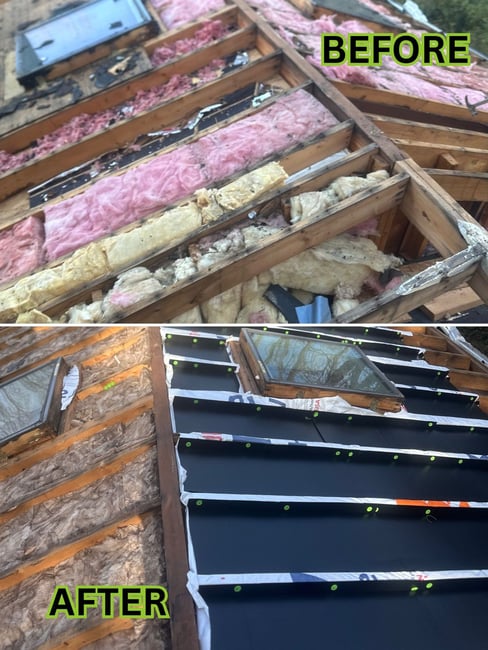
Below is an example of a recent project we completed, where some of the roof deck was rotted due to poor ventilation and a buildup of moisture. We noticed the old insulation extended over the rafters, blocking what little space the air had to flow.
To fix it, we reinstalled the insulation, used intake baffles to keep the insulation from blocking the channels again, and replaced the affected sheets of roof decking. We were careful not to install too much insulation, allowing room for the insulation baffles and air, without sacrificing the roof's ability to regulate temperature:
Intake and Exhaust Vents
Just like a traditional attic, vaulted ceiling ventilation relies on a balance of intake and exhaust. The difference is that, with far less space to work with, airflow has to be managed much more carefully. Air needs to be able to enter at the lower edge of the roof and move evenly through the entire area, rather than getting trapped in one area, like between rafters.
If airflow is uneven, heat and moisture can build up in isolated sections of the roof. Over time, those problem areas are often where damage, condensation, or ice-related issues begin. Here are some important things to consider when it comes to intake and exhaust flow on vaulted ceilings:
-
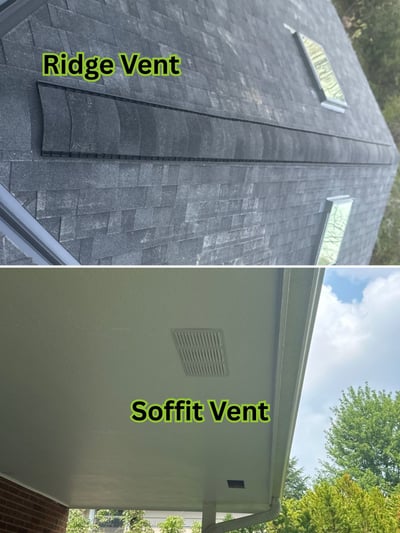
Intake usually comes from soffit vents at the lower edge of the roof. When a roof has overhangs, soffit vents are the most common way to bring fresh air into the roof system. In homes without soffits, intake can be created using products like SmartVents installed along the lower portion of the roof with the shingles themselves for sufficient intake flow.
-
Exhaust typically exits through ridge vents. This type of vent is often the most effective exhaust option for vaulted ceilings because it runs along the entire peak of the roof. It allows warm, moist air to escape evenly from all the channels between rafters, rather than being forced through a single point at one area of the roof.
In a vaulted ceiling, air must travel through narrow, intentional pathways instead of a wide-open attic. If either intake or exhaust is missing, the pathway is blocked, or the wrong type of vents are used, air can't flow properly. Below are examples of both a ridge vent for exhaust and a soffit vent for intake airflow:
How Can You Tell if You Have Poor Roof Ventilation?
Poor roof ventilation often shows up through comfort issues, moisture problems, or premature roof wear, but some of these symptoms can be hard to verify because there's no space (unlike in an attic) for you to see what's going on.
Because vaulted ceilings don't have an attic buffer, ventilation issues tend to reveal themselves more directly inside the home. Knowing what external clues to look for can help homeowners catch problems early, ideally before they turn into costly repairs.
Common Signs of Poor Ventilation in Homes With Vaulted Ceilings
If you have vaulted ceilings and can't visually verify, you may have a ventilation issue if you notice:
-
Rooms that are consistently too hot or too cold: Uneven temperatures or spaces that are difficult to keep comfortable can indicate trapped heat or poor airflow.
-
Condensation or moisture buildup: Foggy windows, damp ceilings, or moisture stains on ceilings can be signs that warm, moist air isn't being exhausted properly.
-
Ice dams or excessive snow melt along roof edges: In colder climates, uneven melting can signal heat buildup inside the roof system. Sometimes there will be a visibly bare part of the roof where the heat buildup is, while the rest of the roof is still snow-covered.
-
Premature roof aging: Shingles that curl, crack, or deteriorate faster than expected may be exposed to excess heat from below, causing the materials to degrade.
-
Musty odors or poor indoor air quality: Trapped moisture can lead to lingering smells or conditions that encourage mold growth. This is hard to confirm before it gets bad, especially without attic access, but the other symptoms we've covered can often indicate a moisture issue.
Because insulation and ventilation are packed into a tighter space, vaulted ceilings leave less room for error. When airflow is restricted or uneven, problems can develop quickly and affect both the roof and the living space below. Below is a video where we show some of the issues that ventilation restriction can lead to:
What Should I Do if I Have Poor Ventilation?
If you suspect your home has poor roof ventilation, especially with a vaulted ceiling, the most important step is to get an assessment of your roof. Ventilation issues aren't always obvious, and the right solution depends on how your roof is built, how air currently moves through it, and where problems are actually occurring.
Because vaulted ceilings don't allow for visual inspection like traditional attic spaces, surface-level fixes or assumptions can easily miss the root cause. A professional inspection can determine whether ventilation is poor, uneven, or blocked, and what improvements should be made, if any.
If you want to learn more about how poor roof ventilation is typically fixed, check out our next article: The Best Ways to Fix Poor Roof Ventilation for Long-Term Results. It covers how poor ventilation can be corrected, and how addressing it can have a positive impact on the longevity of your roof.
We also offer no-commitment consultations to evaluate your entire roof, help you understand what's going on, and outline options that make sense for your home without the obligation to move forward with us.