Why Does Happy Roofing Cost More Than Other Roofers in Naperville?
If you've been comparing quotes from roofing companies in the Naperville area, you may have noticed the large difference in prices from contractors. This range in prices can make you wonder: “What can cause a wide range in roofing quotes?” and “Are we just paying more for the same thing?”
At Happy Roofing, we’re not the cheapest in the area. In fact, we’re often one of the higher-priced options. And if you’re like many homeowners, you’re probably wondering where that cost difference is coming from. You’ve probably heard the saying “you get what you pay for” before, but we believe there’s more to it than that.
In this article, we'll break down exactly why our pricing is often higher than other roofing companies in the Naperville area, and why that difference matters. You'll learn what goes into the cost of a quality roofing system, how some contractors can offer lower quotes, and what to look for in your quote to ensure you're getting what you pay for.
Table of Contents
Are All Roofing Quotes the Same?
No, because not all roofing quotes include the same scope of work, materials, or installation standards. You could receive two quotes for a roof replacement, but the work being done can vary dramatically from one contractor to another. We always advise everyone to look for quotes that break down the scope of work by line item, so you know exactly what you're paying for. Some quotes cover only the bare minimum, while others include the components and craftsmanship needed to ensure your roof performs well for decades, not just a few years.
In fact, many of the lower-cost quotes we see in Naperville leave out critical components that protect your home long term. Your roof is a system made up of more than one component working together to protect your home. This includes the shingles, the underlayment underneath those shingles to keep moisture out, the roof decking that serves as your roof's foundation, and flashings to seal vulnerable areas like seams around chimneys, vents, and skylights.
In many cases, we've seen cheaper roofing options leave certain components (like flashing replacement) out of their quotes to remain competitive. The reality is: this saves homeowners money upfront, but could drastically reduce the lifespan of the "new" roof, and in some instances, this incomplete installation can void any manufacturer's warranties that may have come with the new materials.
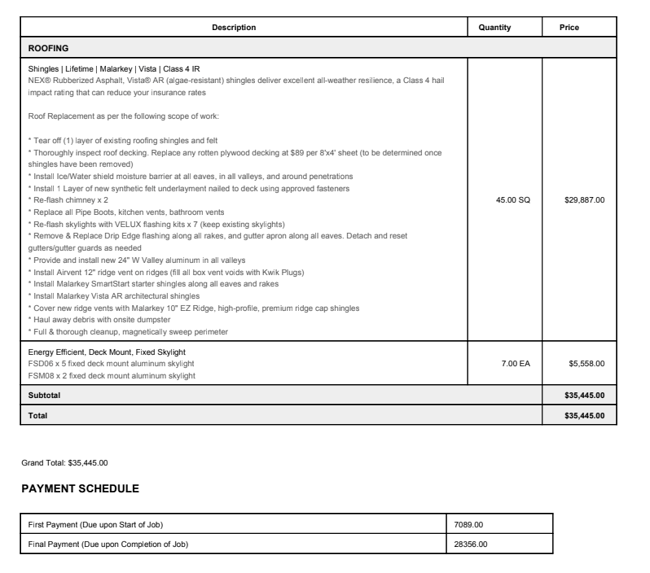
Below is an example of a roofing quote we completed, showing how we include an itemized list describing the materials we're using and a short description of what they are:
 When compared to the following example of a quote that was given to one of our homeowners from another contractor in the area, the difference in detail becomes more apparent:
What's important is that you understand the full scope of your project and why your contractor has recommended what they've included in your quote. If you think something is missing, it's better to ask for clarity rather than assume it's included.
Here's what's often left out of most "budget" roofing quotes:
- Full tear-off of all roofing layers: Some contractors install new shingles directly over the old ones (called an overlay). This may save labor and some material costs, but it can hide underlying damage and often voids manufacturer warranties. We don't offer roof overlays, and instead tear off all of the existing materials to expose the roof decking before installing the new components.
- Laying new shingles over old ones is like painting over an existing wall without first checking for mold, cracks, or water damage. Most walls might be perfectly fine underneath, but you don't know until you look, and if there is a problem hiding back there, painting over it just covers it up and lets the issue get worse.
- A full tear-off is like stripping the wall down, inspecting it properly, fixing anything that needs attention, and then repainting it the right way so it lasts.
- Synthetic underlayment and ice/water shield: Some roofers still use traditional felt underlayment because it's cheaper, but it's also more prone to tearing, water absorption, and deterioration over time. We install high-performance synthetic underlayment, which is stronger, more durable, and provides far better protection for your roof deck. In vulnerable areas like eaves, valleys, and roof penetrations, we use ice and water shield to guard against Midwest freeze-thaw cycles, ice damming, wind-driven rain, and adhere to local building code requirements.
- Cap nails: We secure our underlayment with cap nails (nails with a large plastic head that secures materials, preventing them from tearing) instead of staples because they're designed to hold without tearing the material. Staples may be cheaper (around $15 a box compared to $80 for cap nails), but they can easily puncture or rip underlayment, potentially leading to leaks over time. Most underlayment manufacturers recommend or require the use of cap nails for this reason.
- Proper ventilation system assessment: Poor attic ventilation can shorten the life of your roof and void your shingle warranty. Without proper airflow, hot air and moisture get trapped in your attic, leading to things like mold growth, wood rot, shingle damage, and higher energy bills. We've seen countless roofing quotes that completely exclude ventilation on homes where ventilation isn't sufficient. We assess your intake and exhaust systems to ensure your roof can "breathe" properly, reducing moisture buildup and extending roof life.
- Roof decking replacement: If the decking (usually made from plywood, Oriented Strand Board, or wooden planks) beneath your shingles is soft, warped, or rotting, it must be replaced to ensure your new roof performs as expected. It's impossible to accurately predict how many sheets of decking will need to be replaced before the shingles are torn off, but your contractor should discuss this possibility before any work is agreed to. Many low-cost quotes assume no decking work will be needed, which can lead to surprise costs mid-project or overlooking the decking altogether. We include decking evaluation and replacement as part of a complete, honest scope of work.
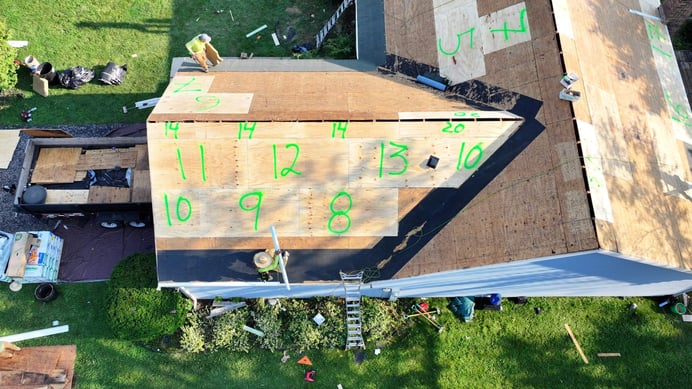
Here is an example of how we like to number any sheets of the roof decking we replace:
Why Happy Roofing's Quotes Can Be Higher Than Others
Because our process is more involved than simply replacing your shingles, our prices can be among the highest in the area. We believe in long-term results and take a solutions-based approach to every roofing project. That means investing in skilled labor, following installation practices that ensure quality workmanship, and using materials we believe in.
We know homeowners are comparing quotes, and we know our process isn't for everyone, but we're not afraid to be the higher number. We don't aim to be the cheapest. We aim to be the most trusted.
Here's a look at what drives our roofing costs higher than other contractors in our area:
- We start with a full inspection to get an accurate sense of your roof's health, so we can provide you with the best options for your situation. Many roofing companies build quotes to win jobs, and we know this because we've had some homeowners show us quotes they received from other contractors while comparing options. We build our roofing quotes to deliver roofs that hold up through Midwest winters, summer storms, and decades of environmental wear. Sometimes, this means additional work that other contractors may have missed or skipped voluntarily, but it's necessary for a durable, high-quality roof installation.
- We assess roof ventilation. Many roofers skip this entirely. Poor ventilation can shorten the life of your roof and void any warranties that may have come with the installation. We've seen time and time again how poor airflow contributes to premature roof wear. Not every home needs ventilation upgrades, but more often than not, we have to cut in additional intake vents or add intake baffles (meant to keep attic insulation from blocking intake vents) during our roof replacements. The cost of these ventilation upgrades, the labor, and any replacement decking that may be needed can add up quickly compared to quotes that ignore ventilation.
- We're quoting you for a full roofing system. As we touched on earlier, some contractors lower their quotes by doing an overlay (installing new shingles directly over the old ones). It saves labor and disposal costs, but it also hides damage and often voids manufacturer warranties. We tear off everything down to the roof decking so we can inspect the structure and install a full new roofing system. While this drives our costs higher, we're including the full replacement of your roof in your quote, so there won't be any surprises after the work begins.
- We replace roof decking when needed. If any part of your wood decking is rotted, soft, or compromised, we replace it. Installing fresh underlayment and shingles over poor decking can lead to early roof failure. If the decking is rotted or warped, the shingles can begin to lift or crack, creating a gap for water to enter the home. While we can't estimate how many new sheets of decking a home will need before we begin the tear-off, we still inform homeowners of the possibility that they'll need some decking replaced. We include a line item on all of our quotes that outlines the cost per sheet of the decking material.
- Even the existing decking gets renailed before the installation of the new components. Over time, nails can back out, causing the roof deck to lift. This can lead to shingle lift, gaps, and leaks. To help prevent the nails from backing out in the future, we use ring-shank nails (these have ridges around the shaft of the nail, increasing their holding power and preventing them from backing out over time) when we secure any roof decking.
- We use synthetic underlayment and cap nails to secure it. Synthetic underlayment is stronger, more water-resistant, and far more durable than traditional felt. Unlike felt (which can absorb moisture, wrinkle, and deteriorate over time), synthetic underlayment lies flat, better resists tearing, and provides a more reliable moisture barrier beneath your shingles. We also secure it with cap nails instead of staples, since staples can create water-prone holes in the underlayment during installation.
This is the kind of detail that doesn't show up on a single line item, and not every roofing contractor approaches roof replacements the same way. It's important to compare the overall scope of work (or line items) rather than the price alone when you're comparing roofing quotes.
Is a More Expensive Roofing Quote Really Worth It?
A more expensive roofing quote is only worth it if the contractor is trustworthy and stands behind their work. Contractors can charge whatever they'd like, but that doesn't always translate to quality work.
We always encourage homeowners to look beyond price and understand what they're receiving when they partner with any roofing company, but as homeowners ourselves, we recognize that cost will always have a significant impact on your final decision. What matters the most is that you trust the contractor that you ultimately choose to work with, and that you understand the details of your quote.
We build our quotes around materials we trust, certified installation, and non-negotiable roofing practices meant to ensure a long-lasting and durable roof. However, we also understand that our approach to roof replacements may not be the best fit for every homeowner.
If you're unsure whether Happy Roofing's approach is the right fit for you, we encourage you to read our next article: Is Happy Roofing the Right Fit for Me? In it, we walk through how we handle our roofing projects, who we're best suited to serve, and how we prioritize trust and transparency at every step.
And if you'd like a clear, honest assessment of your current roof, we offer no-commitment inspections to help you understand exactly what your home needs without any obligation to move forward with us.