Are Flat Roofs More Prone to Leaks?
Whether you’ve noticed water sitting on your flat roof, or you’re worried about a flat roof’s ability to shed water, a common concern among homeowners is: are flat roofs prone to leaks?
At Happy Roofing, we’ve worked on a wide range of flat and low-slope roofing systems throughout the greater Naperville area. We’ve seen flat roofs perform extremely well when they’re built correctly, and we’ve also seen how easy it is for issues to arise when key installation details are overlooked.
Our goal isn’t to worry you or scare you away from flat roofs, but to help you understand where the concern comes from when it comes to how prone these systems are to leaks.
In this article, you’ll learn:
- Whether flat roofs are truly more prone to leaks
- The most common causes of leaks on flat roofing systems
- How a properly installed flat roof is built to drain water effectively
By the end, you’ll have a clearer understanding of how flat roofs work and what to look for if you need to replace yours.
Table of Contents
- Are Flat Roofs More Prone to Leaks Than Pitched Roofs?
- Common Causes of Flat Roof Leaks
- How Flat Roofs Drain Water
- How to Tell If Your Flat Roof Has Drainage Issues
- What to Do If Your Flat Roof Has Drainage Problems
Are Flat Roofs More Prone to Leaks Than Pitched Roofs?
Flat roofs are not inherently more prone to leaks, but they can be more sensitive to poor drainage and installation issues.
When a flat roof is designed and built correctly, it can perform just as well as a roof with a much steeper slope. However, because water can’t run off a flat roof as quickly as it can on a pitched roof, it tends to move more slowly toward drains or edges. This means water may sit on the surface longer, which increases the importance of proper slope and drainage.
Even small problems, like low spots, uneven surfaces, or an inconsistent slope, can allow water to collect and remain on the roof for extended periods. Over time, that standing water can put added stress on seams, flashing, and roofing materials, increasing the likelihood of leaks if anything in the system isn’t installed correctly.
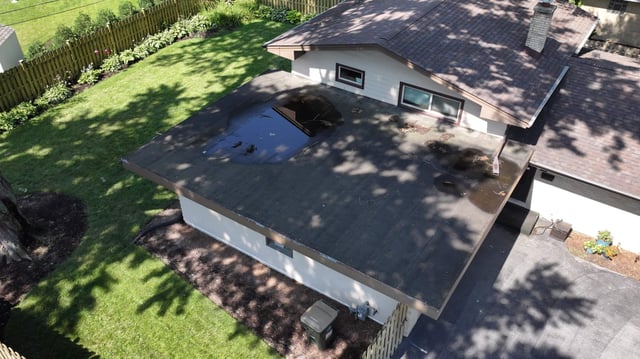
In the photo below, you can see how water has pooled on this flat roof after a rainstorm, indicating low spots where the slope was uneven and lead to trapped water:
What Can Cause a Flat Roof to Develop a Leak Prematurely?
Flat roofs depend on proper design and drainage to move water off the surface since they can’t rely much on gravity alone. This leaves less margin for error, and small oversights in installation can be less forgiving over the course of the roof’s life.
Most flat roof issues come down to a few key factors:
- Drainage: Water needs a clear path off the roof, as standing water increases the risk of leaks by putting prolonged stress on seams, flashing, and other roofing components.
- Slope: Flat roofs aren’t actually flat, they must be built with a slight pitch to prevent the pooling of water. If the roof isn’t sloped correctly or at all, water accumulation can cause leaks to form.
- Installation quality: Flat roofs rely on a multi-layer system including the roof deck, insulation boards, and waterproofing materials. If any layer is installed incorrectly or skipped, it can impact drainage and increase the risk of leaks.
- Surface consistency: Even small dips or one uneven area can prevent proper drainage and lead to long-term water buildup. Flat roofs should maintain a consistent, even slope across the entire surface to ensure water flows in the intended direction.
How Do Flat Roofs Drain Water?
A properly installed flat roof is built with a slight slope, an even surface, and utilizes a layered system to direct water toward drains or edges, preventing it from pooling and causing leaks.
When all of these elements are working together, water is able to move off the roof consistently instead of sitting in one place. If any part of that system is uneven or installed incorrectly, water can collect in low spots and increase the risk of leaks over time.
Flat roof performance comes down to how well the system is designed and installed. The key elements that make this work are all centered around how the roof is sloped, built in layers, and set up to move water off the surface effectively:
- The structural deck (foundation of the system): Every flat roof starts with a solid base, typically plywood or Oriented Strand Board. This is what the rest of the roofing system is built on, and if the deck itself isn’t level or has deflection, that inconsistency will carry over to the surface materials, and it can create areas where water naturally collects over time
- Insulation boards: Insulation boards are installed on top of the roof deck primarily to improve energy efficiency and regulate temperature inside the building. In many flat roof systems, these boards are also tapered to create the slight, consistent slope needed for drainage. If they’re installed unevenly, or if the tapering isn’t planned correctly, they can create uneven low spots that trap water and lead to pooling over time
- Continuous waterproofing membrane: Materials like TPO (thermoplastic polyolefin), EPDM (ethylene propylene diene monomer), or modified bitumen (asphalt-based roofing system) are installed over the insulation to create a watertight surface. This acts as the primary barrier against water intrusion. Unlike shingles that shed water quickly, this layer is designed to keep water and moisture out, which is why proper installation and seam integrity are critical.
- Seams and penetrations: Flat roofs rely heavily on sealed seams where materials meet, as well as around penetrations like vents or HVAC units. Because water may sit on the surface longer, these areas must be installed precisely to prevent leaks over time.
- Drainage components: Flat roofs are designed to move water toward specific exit points such as internal drains, scuppers (openings along the roof edge that let water drain off), or edges and gutters. The entire system (deck, insulation, membrane) should work together to guide water to these locations, not leave it to sit randomly on the surface.
How Can You Tell if Your Flat Roof Has Drainage Issues?
You can tell your flat roof has drainage issues if water consistently pools on the surface, drains slowly, or if you notice recurring leaks, uneven areas, or premature wear in specific spots. Because the design of flat roofs naturally moves water more slowly than roofs with more aggressive slopes, small problems aren’t always obvious right away.
But over time, they tend to show up in ways you can spot if you know what to look for. Even if you’re not a roofing professional, there are a few clear signs that can indicate whether your flat roof is draining properly.
How You Can Evaluate Your Flat Roof’s Drainage
| Signs Your Flat Roof Is Draining Properly | Signs Your Flat Roof May Have Drainage Issues |
|---|---|
| Water drains off the roof promptly, typically within 24–48 hours after a rainfall | Water remains on the roof long after rainfall, indicating poor drainage |
| Water may briefly collect but does not consistently pool in the same areas | Water repeatedly collects in the same spots after every rain, showing low areas or slope issues |
| The roof surface appears consistently level with no noticeable depressions | Visible dips or uneven sections allow water to settle instead of flowing off |
| Roofing materials appear to wear evenly across the surface | Certain areas show faster wear, discoloration, or deterioration |
What Should You Do If You Have a Flat Roof and Notice Drainage Issues?
When a flat roof is installed correctly, with proper slope, consistent layering, and a clear path for water to drain, it can perform just as well as a pitched roof. But minor issues in design or installation could lead to standing water and leaks over time.
If you’re seeing signs like standing water, recurring leaks, or visibly uneven areas, it doesn’t necessarily mean you need a full roof replacement, but it does mean it’s worth taking a closer look in order to stay ahead of any potential concerns. In some cases, these issues can be identified and addressed early before they turn into more costly problems.
At Happy Roofing, we offer non-commitment roof consultations to help homeowners understand what’s going on with their roof and what their options are without the obligation to work with us. We’ll assess your roof, show you what we find, and discuss your options so that you have all the information you need to make the best decision for you and your home.



.jpg?width=700&name=Title%20Cover%20Template%20(3).jpg)